50 Stories for 50 Years | Post 20
On come-arounds, collapsing mid-song, and what happens when development and punishment share a room.
Tucked inside the little book every plebe carried everywhere, Reef Points, our pocket-sized bible of professional knowledge, were the things we were expected to know cold. Ship terminology. Naval history. The chain of command. Customs and courtesies. Rates.
You were tested on all of it. Formally, in class. Informally, in the passageway, where any upperclassman could stop you mid-stride and ask you something you had better know.
And then there were come-arounds.
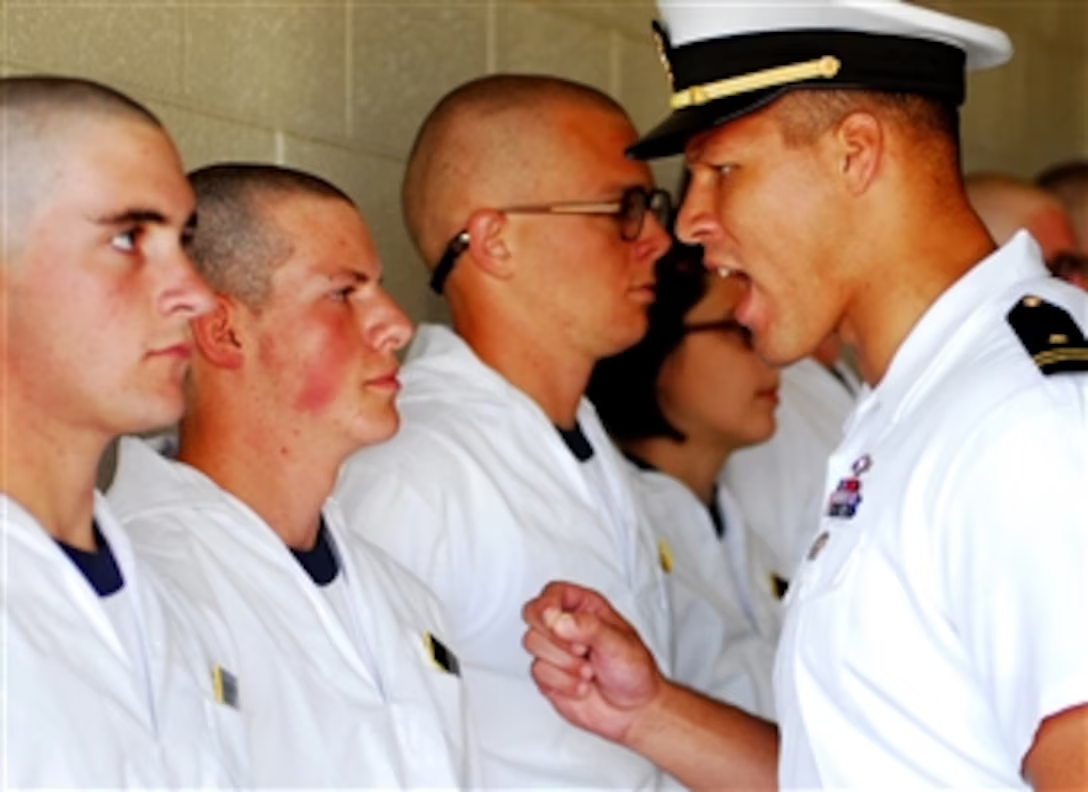
A come-around was exactly what it sounds like. A scheduled summons, usually timed right before evening meal formation, to report to an upperclassman’s room. You stood at attention in the doorway, or just inside it, and you were grilled. Pro-Know. Current events. Rates. The kind of interrogation designed less to humiliate you than to force the information into your bones, to make you so tired of not knowing that you would finally make yourself know.
The juniors ran most of them. The second class had the most to prove about how seriously they took their role in the system, and they took it seriously indeed. Seniors tended toward a closer form of oversight. The second class were in it.
You could also be called to a come-around outside the schedule. If an upperclassman observed a gap in your bearing, your knowledge, your readiness, they could call you in. The come-around was both a tool of development and a consequence. That dual nature was, I suspect, the point. It was also sometimes the problem.
There was one come-around I have never forgotten.
It was a home football game Saturday, which meant the march-on, a thirty-minute march of the Brigade from the Academy grounds to the stadium, in Service Dress Blue uniform, the Navy Band playing us into step. The company moved together, and as we moved, we were expected to sing.
We weren’t singing loud enough.
Our second class let us know. Louder. Then again: Louder. We pushed. Apparently not enough. By the time we reached the stadium, the verdict was in, and so was the come-around.
I showed up at Mr. M’s room on Monday, stood at attention, and waited for my instructions. They were simple: sing.
One of the march-on songs. At the top of my voice.
I had sung in high school choirs. I knew how to project, how to blend, how to use the full column of my breath. But choir singing and plebe singing are two different animals. One is technique. The other is volume beyond technique, a physical demand issued by someone with authority.
I sang. I pushed. I gave it everything I had at the end of a day that had taken most of what I started with.
And then I felt it — the edges of my vision going soft. A kind of rushing in my ears. The room tilting.
I went down.
I didn’t go down gracefully. I swayed first, the way exhausted people do, and then I was on the floor, woozy, the song still ringing somewhere above me.
Mr. M moved immediately. Whatever he had been two minutes before, evaluator, enforcer, the authority in that room, he was something else now. He reached out to steady me. The voice that had been demanding volume was concerned. Careful.
And I was furious.
Not at him, exactly. Or maybe at him a little. But mostly I was furious at myself for having shown weakness in front of someone I could not afford to show weakness to. Furious at my body for its failure of will. Furious at the whole situation for collapsing into something human when I needed it to remain a test I could pass.
I can get up myself. Thank you, sir.
I have no memory of what he said when he dismissed me. Something about making sure I was alright. I walked back to my room and did what you do when you’re a plebe who has just fainted in front of a second classman: you close the door, you feel everything you are not allowed to feel in public, and then you prepare for the next thing.
Come-arounds worked. I want to say that plainly, because the story of me on the floor could be read as an argument against them, and I don’t think that’s the right conclusion.
The system of structured accountability, someone always watching, someone always testing, someone whose job it was to care whether you knew your rates, produced midshipmen who knew things. Not just recalled them for an exam. Knew them. In their bones, under pressure, at the end of a long day, with a band playing and a formation around them and a second classman measuring the volume of their voice.
That’s not incidental to the profession. That’s the profession.
What I have thought about in the years since is the moment Mr. M changed registers. The moment development stopped, and something else stepped in. There is a version of that story where he doesn’t reach out, where he waits to see whether I get up on my own, where he treats the fall the way he had been treating the singing, as another data point in my performance. He didn’t do that.
He didn’t do that, and I was too angry to appreciate it then.
Leadership at its best knows how to hold both things: the standard and the person. The demand and the recognition that the person is not only the performance. The best come-around I ever experienced wasn’t the one I failed. It was the ones where someone knew something about me afterward that they hadn’t known before. not a weakness to be exploited, but a shape, a limit, a human contour, and adjusted accordingly. Without lowering the bar. Without excusing the gap. Just: knowing.
The worst come-arounds were the ones that forgot the other person was in the room.
That distinction, between a come-around that develops and a come-around that only punishes, turns out to matter quite a lot. Not just in Bancroft Hall. In every room where someone with authority over you decides what to do with what they’ve just seen.
I eventually made my peace with Mr. M. With the song, with the floor, with the fact that I’d shown him something I didn’t mean to.
Which is what come-arounds were always trying to produce. Not perfection. Not performance that never falters. But someone who gets back up, with or without help, and returns to formation.
Years later, I crossed paths with Mr. M at a duty station. Not as a plebe and a second-classman. As sailors. As companymates. The distance that had defined every interaction in Bancroft Hall, the doorway I stood in, the attention I held, the sir at the end of every sentence, had dissolved into something else entirely. We were just two people who had come up through the same hard thing, and the meeting had the easy warmth of people who share a history they don’t have to explain to each other.
That’s the other thing the system was building, underneath all of it. Not just the rates, the formations, and the volume. It was building the foundation of a fellowship that would outlast the hierarchy, one that would surface years later, in a passageway somewhere, when two former company mates recognized each other across the ranks they used to hold.
He probably doesn’t remember the night I hit the floor. I remember it. And I’m glad the last version of that story is the one where we shared a drink as friends.
Thank you, sir.
50 Stories for 50 Years marks the 50th anniversary of women at the United States Naval Academy.